
Introduction: Foreign Subsidiary Compliance in India:
A foreign subsidiary compliance checklist in India covers MCA annual filings, statutory audits, income tax and GST compliance, FEMA and RBI reporting, transfer pricing, and applicable employment laws. The specific obligations and deadlines depend on the company's ownership structure, business activities, transactions, and applicable statutory provisions.
A foreign subsidiary incorporated in India must comply with applicable corporate, tax, foreign investment, and employment laws. Maintaining a compliance calendar and accurate records helps companies track filing deadlines, meet regulatory obligations, and manage compliance risks. Regular reviews of applicable statutory requirements also help ensure that the subsidiary fulfils its independent legal and regulatory responsibilities.
What Is a Foreign Subsidiary Company in India?
A foreign subsidiary company in India is a company incorporated under Indian law in which a foreign parent company exercises control in accordance with Section 2(87) of the Companies Act, 2013. This includes control over the composition of the Board of Directors or control over more than one-half of the total share capital, subject to the statutory definition.
Unlike a branch office, which operates as an extension of a foreign company subject to applicable regulatory permissions and conditions, an Indian subsidiary has a separate legal identity. Its incorporation and corporate governance are governed by the Companies Act, 2013. Foreign investment in the subsidiary must also comply with applicable FEMA regulations, RBI directions, India's FDI policy, and sector-specific conditions.
Quick-Reference Checklist for Foreign Subsidiaries in India:
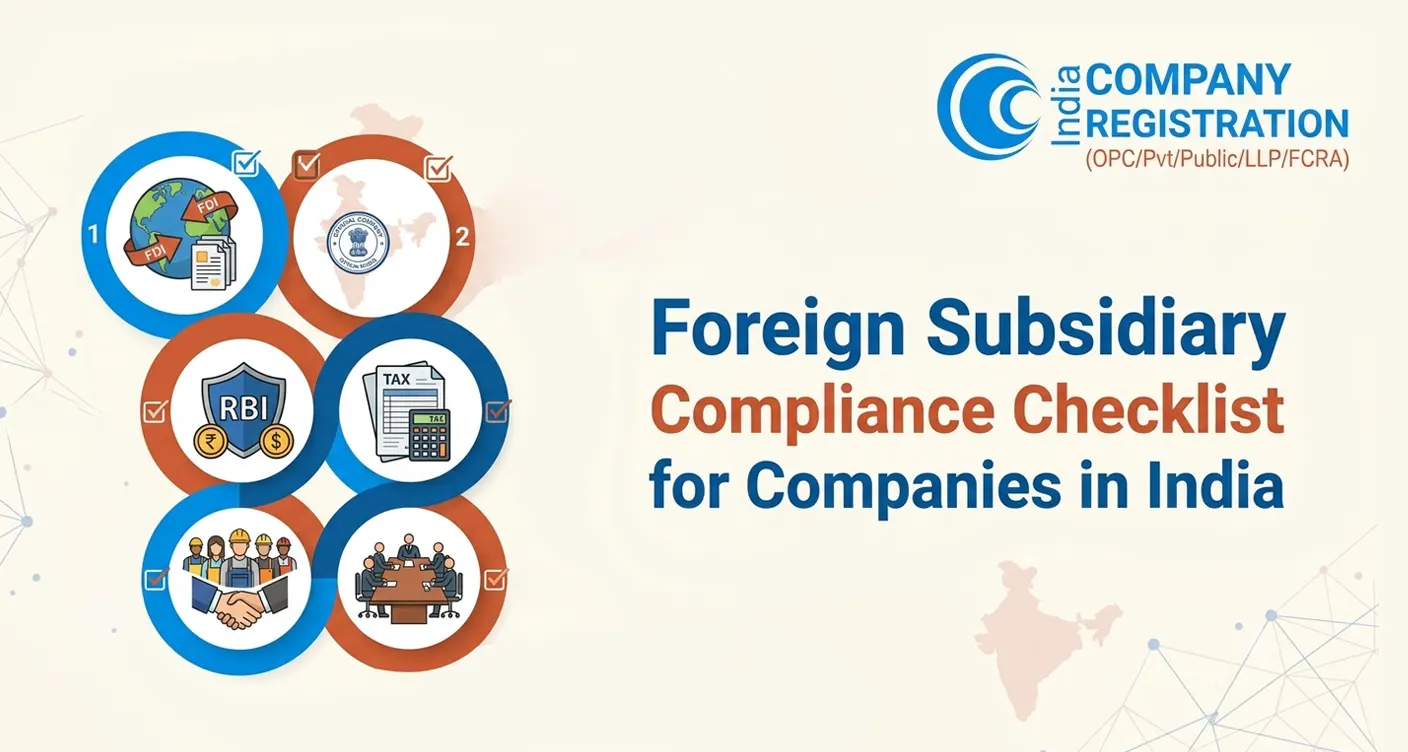
The following compliance checklist for foreign subsidiaries in India highlights the principal corporate, tax, foreign investment, and operational obligations that companies should assess.
- MCA Filings and Corporate Records: File applicable financial statements and annual returns, and maintain statutory registers and corporate records.
- Board Meetings and Annual General Meetings: Conduct meetings and maintain minutes in accordance with applicable provisions and exemptions.
- Statutory Audit: Prepare financial statements and arrange a statutory audit as required under company law.
- Income Tax Compliance: File the applicable corporate income tax return and complete a tax audit where required.
- GST Compliance: Obtain GST registration, file returns, and meet applicable payment and record-keeping requirements.
- FEMA and RBI Reporting: Complete applicable foreign investment reporting and comply with foreign exchange regulations.
- Transfer Pricing Compliance: Identify related-party international transactions, determine arm's length prices where required, and maintain prescribed documentation.
- Employment and Industry-Specific Compliance: Meet applicable EPF, ESI, POSH, state labour law, and sector-specific requirements.
Foreign Subsidiary Compliance Deadlines in India:
| Compliance Requirement | Form/Provision | General Due Date |
|---|---|---|
| Annual General Meeting (AGM) | Section 96, Companies Act, 2013 | Within six months of the financial year-end, subject to applicable provisions |
| Filing of Financial Statements | Form AOC-4 | Within 30 days of the AGM |
| Filing of Annual Return | Form MGT-7 | Within 60 days of the AGM |
| Auditor Appointment Filing | Form ADT-1, where applicable | Generally within 15 days of the auditor's appointment |
| Reporting Issue of Equity Instruments to Foreign Investors | Form FC-GPR | Generally within 30 days of the issue of equity instruments |
| Annual Foreign Liabilities and Assets Return | FLA Return | Generally by 15 July, where applicable |
| Accountant's Report for Transfer Pricing | Form 3CEB | By the applicable statutory specified date |
The above timelines are general references and may depend on the relevant statutory provisions, transaction dates, reporting requirements, and applicable extensions. Companies should verify the current filing rules and deadlines before submission. Missing a statutory deadline may result in additional fees, interest, penalties, or other consequences, depending on the applicable law.
MCA Compliance Requirements for Foreign Subsidiaries:
Foreign subsidiaries incorporated in India must meet applicable MCA compliance requirements under the Companies Act, 2013. These generally include annual filings, board meetings, statutory audits, and maintaining corporate records. The following table outlines the key MCA filing requirements for foreign subsidiary companies and relevant forms.
| Compliance Requirement | Relevant Form/Provision | Purpose and Requirement |
|---|---|---|
| Financial Statements | Form AOC-4 | File financial statements with the MCA |
| Annual Return | Form MGT-7/MGT-7A | Report shareholders, directors, and company details |
| Board Meetings | Section 173 | Hold meetings as prescribed by law |
| Hold meetings as prescribed by law | Section 96 | Hold the AGM within the prescribed timeline |
| Statutory Auditor | Section 139, Form ADT-1, where applicable | Appoint an auditor and complete required filing |
| Director KYC | DIR-3 KYC or applicable web-based process | Complete annual director KYC requirements |
| Disclosure of Interests | Section 184, Form MBP-1 | Record directors’ interests in other entities |
| Director Disqualification | Section 164, Form DIR-8 | Obtain declarations regarding disqualification |
| Statutory Registers | Companies Act, 2013 | Maintain required registers and corporate records |
The applicable MCA forms, filing deadlines, and exemptions depend on the company's circumstances. Companies should maintain a compliance calendar to track annual filings, board meetings, auditor appointments, director KYC, and other applicable statutory requirements.
FEMA and RBI Compliance for Foreign Investment:
Foreign subsidiaries must comply with applicable FEMA compliance requirements for foreign subsidiaries and RBI regulations governing foreign investment transactions. Depending on the transaction, obligations include reporting share issues or transfers, filing the FLA return where applicable, and maintaining investment records. The following table summarizes the key RBI reporting requirements for foreign subsidiaries.
| Compliance Requirement | Applicable Rule/Form | Key Compliance Obligations |
|---|---|---|
| Foreign Direct Investment (FDI) | FEMA and RBI regulations | Receive foreign investment through permitted channels and complete required reporting |
| Issue of Shares to Foreign Investors | Form FC-GPR | Report the issue of equity instruments within the prescribed timeline, generally 30 days |
| Annual FLA Return | FLA Return | File the annual return, generally by 15 July, if applicable |
| Sectoral Caps and Entry Routes | FEMA and FDI Policy | Check foreign investment limits, entry routes, and approval requirements |
| Pricing and Investment Records | FEMA pricing rules and RBI regulations | Follow pricing norms and maintain valuation reports, remittance proof, and share records |
Foreign subsidiaries should maintain records of foreign capital received, share issues and transfers, valuation reports, remittance evidence, and investment agreements. They should also verify applicable FEMA and RBI reporting requirements, deadlines, and exemptions for each transaction.
Tax Compliance Checklist for Foreign Subsidiaries:
Foreign subsidiaries must meet applicable tax compliance requirements in India, including income tax, GST, TDS, and advance tax obligations, along with tax audit requirements where applicable. The following table summarizes the relevant tax provisions, forms, and tax obligations of foreign subsidiary companies in India.
| Tax Compliance Requirement | Applicable Form/Provision | Applicable Form/Provision |
|---|---|---|
| Corporate Income Tax Return | Income-tax Act, 1961; ITR-6, where applicable | File the annual return and report taxable income and tax liability |
| Tax Audit | Section 44AB; Forms 3CA/3CB and 3CD, as applicable | Complete the tax audit and maintain financial records, where required |
| TDS Compliance | Applicable TDS provisions and forms | Deduct, deposit, and report tax at source within prescribed timelines |
| GST Compliance | CGST Act, 2017; GSTR-1 and GSTR-3B, as applicable | Obtain registration, file returns, pay dues, and claim eligible ITC |
| Obtain registration, file returns, pay dues, and claim eligible ITC | Applicable Income-tax Act provisions | Pay advance tax and meet applicable withholding obligations |
Foreign subsidiaries should periodically reconcile financial statements, income tax records, GST returns, and tax payments. Cross-border payments to foreign parent companies should also be reviewed for withholding tax, applicable tax treaty provisions, and transfer pricing implications.
Transfer Pricing Compliance for Transactions with Foreign Parent Companies:
Transfer pricing compliance in India may apply to international transactions between an Indian subsidiary and its associated enterprises. Requirements may include determining arm's length prices, maintaining prescribed documentation, and filing Form 3CEB where applicable. The following table outlines the main obligations.
| Compliance Requirement | Applicable Provision/Form | Key Compliance Obligation |
|---|---|---|
| Transfer Pricing Applicability | Sections 92–92F | Identify international transactions with associated enterprises |
| Arm’s Length Pricing | Section 92C | Determine prices using prescribed methods |
| Transfer Pricing Documentation | Section 92D, Rule 10D | Maintain records supporting transaction pricing |
| Accountant’s Report | Section 92E, Form 3CEB | Obtain and file the prescribed report within the statutory deadline |
| Penalties for Non-Compliance | Sections 271AA, 271BA, and other applicable provisions | Non-compliance may attract penalties and tax adjustments |
Foreign subsidiaries should retain agreements, invoices, benchmarking studies, and financial records to support their transfer pricing positions. They should also verify applicable documentation requirements, reporting obligations, exemptions, and statutory deadlines.
Employment and Other Operational Compliance:
Foreign subsidiaries must also assess employment compliance requirements in India, including EPF, ESI, POSH, state labour laws, and industry-specific licences, depending on the applicable statutory conditions. The following table summarizes the key obligations.
| Compliance Requirement | Key Obligation |
|---|---|
| EPF and ESI | Register and contribute where applicable |
| Professional Tax and Labour Laws | Meet state-specific tax and employment requirements |
| Shops and Establishments Registration | Register or notify authorities as required by state law |
| POSH Compliance | Implement workplace sexual harassment prevention procedures and form an Internal Committee where legally required |
| Industry-Specific Licences | Obtain applicable sectoral licences and approvals |
Common Foreign Subsidiary Compliance Mistakes to Avoid:
- Missing MCA annual filing deadlines or applicable income tax return deadlines.
- Failing to complete required FEMA and RBI reporting within the prescribed timelines.
- Not maintaining agreements, invoices, valuation reports, and other supporting documents for transactions with foreign-associated enterprises.
- Failing to reconcile financial statements with income tax, GST, and foreign investment records.
- Overlooking event-based filings following changes in directors, shareholding, or registered office.
- Treating the Indian subsidiary as an extension of the foreign parent instead of recognizing its independent statutory responsibilities.
How to Maintain a Foreign Subsidiary Compliance Calendar:
A compliance calendar for foreign subsidiaries in India helps businesses organize statutory obligations, assign responsibilities, and monitor upcoming filing deadlines. Companies can use the following steps to manage recurring and event-based compliance requirements.
- Record deadlines for MCA filings, income tax returns, GST returns, and applicable RBI reporting.
- Assign responsibility for each compliance task to the relevant finance, tax, legal, or company secretarial team.
- Reconcile MCA filings, tax records, GST returns, and foreign investment reporting records periodically.
- Monitor amendments to applicable laws, rules, forms, and filing requirements.
- Record evidence of completed filings, payment receipts, acknowledgements, and supporting documents.
Conclusion:
Maintaining a structured foreign subsidiary compliance checklist in India is essential for companies operating under India's corporate and regulatory framework. Obligations may include MCA filings, statutory audits, income tax and GST compliance, FEMA and RBI reporting, transfer pricing documentation, and applicable employment requirements.
The specific compliance requirements for foreign subsidiaries depend on the company's activities, ownership structure, transactions, and applicable laws. A well-maintained compliance calendar, accurate records, timely filings, and periodic legal and tax reviews can help companies manage compliance risks and meet their independent statutory responsibilities.
Frequently Asked Questions (FAQs)
A foreign subsidiary is an Indian-incorporated company controlled by a foreign parent company under the Companies Act, 2013.
Key requirements include MCA filings, statutory audits, income tax, GST, FEMA and RBI reporting, and applicable labor laws.
Yes, it must file applicable annual returns and financial statements with the MCA.
Common forms include AOC-4 and MGT-7 or MGT-7A, as applicable.
It involves meeting applicable foreign exchange rules for foreign investment, share issues, transfers, and reporting.
Form FC-GPR is generally used to report the issue of equity instruments by an Indian company to a person resident outside India.
It involves applying arm's length principles to applicable international transactions with associated enterprises and meeting related documentation and reporting requirements.